Act I · Chapter 01
The Old Sky
What happens when some lights will not stay put?
Begin outside. Before spacecraft, before a ring diagram, before a god. The sky is a field of lights that keep their places relative to one another, and a handful that wander.
Greek astronomers called those five naked-eye wanderers planētai: Mercury, Venus, Mars, Jupiter, Saturn. The word is a historical astronomical category. It names apparent motion against the fixed stars. It is not a mystical slogan, and it does not yet mean world.
Before planets were worlds, they were lights that wandered.
The ancient category begins with apparent motion, not with modern knowledge of planetary worlds.
Of the five lights that will not stay put, Saturn is the slowest to the unaided eye, and the farthest of those five. A careful watcher can follow it for years and still see only part of one return.
Ancient observers knew a light that lagged, not a distance in astronomical units. Slowness was the observation. Distance is a later measurement.
In the classical ordering of the planetary spheres, Saturn stands first because it is the highest and slowest: Saturn → Jupiter → Mars → Sun → Venus → Mercury → Moon, or, among the five wanderers, Saturn → Jupiter → Mars → Venus → Mercury.
This does not mean Saturn was the first planet discovered. It means that in a geocentric cosmos, the slowest wanderer occupied the farthest crystalline office. Modern solar-system order is a different model. They are two pictures of the same lights, drawn for different centers.
Classical spheres · slowest is farthest
- 1Saturnslowest · farthest
- 2Jupiter
- 3Mars
- 4Sunan office, not the center
- 5Venus
- 6Mercury
- 7Moonfastest · nearest
- Saturn
- Jupiter
- Mars
- Sun
- Venus
- Mercury
- Moon
Among the five wanderers
- Saturn
- Jupiter
- Mars
- Venus
- Mercury
Saturn stands first because it occupied the highest, slowest sphere. The Sun is an office in this picture, not its center. Rank is apparent slowness, not kilometers.
A slow light invites a name. The Greek star-name comes before any god-name is allowed to speak.
Act I · Chapter 02
What the Light Was Called
What was the light called before it was Saturn?
- Star-namePhainon
- God-nameKronos
- Roman nameSaturnus
Greek astronomical language gives the outermost wanderer a descriptive name: Φαίνων. Phainon, Latinized Phaenon, “the shining one.” In the set preserved through Aristotle and the Epinomis, the five are Phainon, Phaethon, Pyroeis, Phosphoros, Stilbon.
Phainon is a star-name. Kronos is a god-name. Saturn is a later Roman name for both a god and, by identification, a planet. These are not the same word doing the same job.
Reception · CiceroCicero, in De Natura Deorum, transmits Phaenon as the Greek name of the star the Romans call Saturnus: reception, not origin.


Mesopotamian celestial science named this wanderer independently. In Akkadian, Kajamānu (Kayyāmānu) is attested as a name of Saturn: “the constant,” “the steady one,” a name that fits a slow light. Francesca Rochberg’s The Heavenly Writing is the scholarly door into that world as writing, omen, and observation, not as costume.
Enūma Anu Enlil is not “ancient astrology” as a personality column. It is a long scholarly practice in which celestial appearances could be read in relation to king, weather, harvest, and war. Observation, record, and interpretation sit in different drawers of the same desk.
Recover Greek Kronos in his own religious and literary world before planetary association. He is a Titan, a father, a harvester of succession, a figure of the Golden Age in some tellings and of swallowed children in others. Agriculture, kingship, violence and time all attach to him, but not all at once, and not all from the same texts.
Later antiquity plays Kronos against chronos, time. Cicero repeats the cleverness: Saturn as saturated with years. That etymology is reception. It is not a physical claim, and it is not the original office of the wanderer Phainon. The equation “Kronos = time” is a later pun, not ancient law.
HistoricalKronos is the Theogony figure: harvest, succession. Chronos is Time. They were not always the same.
Roman Saturn is Roman religion and civic memory, not simply renamed Kronos. He is bound to sowing, wealth, the Temple of Saturn on the Forum, which held the state treasury, and to a Golden Age that Romans could remember as a political story as much as a myth.
Identification with Kronos happened, and it mattered. It does not erase Saturn’s own rites, his pairing with Ops, or the civic functions of his house. Recover the Roman god as Roman before using him as a mask for a Greek Titan or a planet.
Disclosure · festivalSaturnalia begins on 17 December. Later it lengthens. There is gift exchange, gambling, freed speech, a carnival of inversion in which the ordinary ranks of a slave society are ritually loosened. It is not “Roman Christmas.” Christmas has its own history. Saturnalia has its own.
Once a year the civic calendar scheduled a pause in severity. That pause has a name, a date, and a limit.
Act II · Chapter 03
The Instrument Changes What Can Be Seen
What do you call a thing your instrument can see but your world cannot yet explain?

Instrument · 1 of 4
oOoPadua · 30 July 1610 · not yet a ring
A tube of glass
Padua, 30 July 1610. Galileo writes that the star of Saturn is not one, but three, which almost touch, arranged oOo. This is not a ring theory. He has no word yet for what the tube showed.
I have observed the highest planet to have a triple form.
The same summer he sent the seeing as a jumble of thirty-seven letters, so the date could be proved without naming the object. Kepler guessed two moons of Mars. The letters, opened on 13 November 1610, were Saturn.

Instrument · 2 of 4
Handles become a ring
In 1655 Christiaan Huygens discovers Titan. In 1659, Systema Saturnium argues that Saturn’s strange appendages are a thin, flat ring surrounding the planet, not touching it. Better optics plus geometry: the disappearing handles become a model.
Instrument · 3 of 4
A ring with a hole
In the 1670s Giovanni Domenico Cassini sees a gap between what we now call the A and B rings. NASA’s public figure for that Cassini Division is about 4,700 kilometers (2,920 miles) across. A ring with a hole is already not a simple hoop.

Instrument · 4 of 4
Not one thing
Maxwell, in 1859, shows that a solid ring would be unstable. The rings must be innumerable particles on independent orbits. James Keeler’s spectroscopy in 1895 watches the inner parts move faster than the outer.
Recorded
This is not a ring theory. He has no word yet for what the tube showed. He has three bodies that almost touch, a row along the Zodiac, and a sketch made of letters: oOo. He asks that it be kept secret until print, and still sends it, so that if another eye finds the same wonder, Florence will already have the date.
Recorded · 1659
Christiaan Huygens, Systema Saturnium.
The appendages are a thin, flat ring, detached from the globe, which appears and vanishes with changing geometry of view.
Limit: Huygens still took the ring to be solid. Titan is named later; he called it simply Saturn’s moon. Particle theory is Maxwell, two centuries on.
Recorded · 1859 (Adams Prize)
Maxwell, On the Stability of the Motion of Saturn’s Rings.
A solid ring would be unstable. The rings must be innumerable independent masses.
Limit: Maxwell did not photograph particles. Keeler’s 1895 spectroscopy showed inner parts moving faster than outer: Kepler’s law, written in ice.
Archival disclosure · Galileo’s letters, 1610
Padua · to Belisario Vinta, secretary to Cosimo II · 30 July 1610
Un’altra stravagantissima meraviglia
Ho cominciato il dì 25 stante a vedere Giove orientale mattutino, con la sua schiera de’ Pianeti Medicei, et più ho scoperto un’altra stravagantissima meraviglia, la quale desidero che sia saputa da loro Altezze et da Vostra Signoria, tenendola però occulta, sin che nell’opera che ristamperò sia da me publicata.
Ma ne ho voluto dar conto a loro Altezze Serenissime, acciò se altri l’incontrasse, sappino che niuno la ha osservata avanti di me; se ben tengo per fermo che niuno la vedrà se non dopo che ne l’haverò fatto avvertito.
Questo è, che la stella di Saturno non è una sola, ma un composto di 3, le quali quasi si toccano, né mai tra loro si muovono o mutano; et sono poste in fila secondo la lunghezza dello Zodiaco, essendo quella di mezzo 3 volte maggiore delle altre 2 laterali, et stanno situate in questa forma:
oOo
On the 25th of this month I began to see Jupiter in the morning east, with his band of Medicean planets. And further I have discovered another very strange wonder, which I desire their Highnesses and Your Lordship to know, keeping it secret until I publish it in the work I shall reprint.
I have wished to give an account of it to their Most Serene Highnesses, so that if others hit upon it they may know that no one has observed it before me; though I am quite sure no one will see it unless I have first called attention to it.
This is, that the star of Saturn is not a single star, but a composite of three, which almost touch each other, never move or change among themselves, and are placed in a row along the length of the Zodiac, the middle one being three times larger than the two laterals, and they are situated in this form:
oOo
Florence · to Giuliano de’ Medici in Prague, for the Emperor and for Kepler · 13 November 1610
Altissimum planetam tergeminum observavi
Le lettere dunque, combinate nel loro vero senso, dicono così:
Altissimum planetam tergeminum observavi.
Questo è, che Saturno, con mia grandissima ammirazione, ho osservato essere non una stella sola, ma tre insieme, le quali quasi si toccano; sono tra di loro totalmente immobili, e costituite in questa guisa oOo; quella di mezzo è assai più grande delle laterali; sono situate una da oriente e l’altra da occidente, nella medesima linea retta a capello; non sono giustamente secondo la dirittura del zodiaco, ma la occidentale si eleva alquanto verso borea; forse sono parallele all’equinoziale.
Se si riguarderanno con un occhiale che non sia di grandissima multiplicazione, non appariranno 3 stelle ben distinte, ma parrà che Saturno sia una stella lunghetta in forma di una uliva; ma servendosi di un occhiale che multiplichi più di mille volte in superficie, si vedranno li 3 globi distintissimi, e che quasi si toccano, non apparendo tra essi maggior divisione di un sottil filo oscuro.
Or ecco trovata la corte a Giove, e due servi a questo vecchio, che l’aiutano a camminare né mai se gli staccano dal fianco.
The letters, joined in their true sense, say this: I have observed the highest planet to have a triple form.
That is, that Saturn, with my greatest astonishment, I have observed to be not one star alone, but three together, which almost touch; they are wholly motionless among themselves, and arranged in this guise oOo; the middle one is much larger than the laterals; they sit one to the east and the other to the west, in the same straight line to a hair; they are not exactly along the line of the Zodiac, for the western one rises a little toward the north; perhaps they are parallel to the equinoctial.
If they are looked at with a glass that is not of the greatest multiplication, they will not appear as three stars well distinct, but Saturn will seem a somewhat long star in the form of an olive; but using a glass that multiplies more than a thousand times in surface, the three globes will be seen most distinctly, almost touching, with no greater division between them than a thin dark thread.
So here is a court found for Jupiter, and two servants for this old man, who help him walk and never leave his side.
If the ring is particles, how wide, how thin, and of what? The ring becomes a measured object.
Act III · Chapter 04
A World of Ice
How can something this wide be this thin?
10 mtypical thicknessAbout 30 feet.
282,000 kmradial extentFrom the planet, out through the main rings.

The rings are billions to trillions of icy and rocky particles, from dust to house-sized chunks, a few as large as mountains, orbiting at different speeds. Starting at Saturn and moving out: D, C, B, Cassini Division, A, F, G, E, and far beyond, a faint Phoebe ring. The main rings are A, B, and C.
A Roche limit is a physical answer to a question this house will later ask in another register: what is a limit for? Inside that tidal boundary, ice cannot easily gather itself into a moon. The ring is what the limit permits.

Voyager saw them; Cassini watched them come and go. Radial, wedge-like dark or bright features in the B ring, made of tiny icy particles lifted by electrostatic charge. They can stretch more than 10,000 miles, longer than Earth’s diameter, and last hours. Formed and gone, Cassini’s team said, in the time it takes to eat breakfast.
They vanished from view around Saturnian equinox years and returned. A ring can be both architecture and weather.

Some edges do not dissolve into smoothness. Small moons are negotiating them.
Act III · Chapter 05
A Small Moon Keeps a Lane
How can a small moon keep a 42-kilometer lane?
42 kmKeeler GapA lane in the outer A ring. Daphnis, about 8 km across, orbits inside it and raises waves along both edges.
Measured · Keeler Gap · 42 km

Prometheus and Pandora, among others, orbit in relation to ring material and help keep edges and the narrow F ring from dissolving into smoothness. A moon does not command ice by symbolism. Gravity rearranges orbits. Gaps, waves and wakes are negotiated.
Near the outer edge of the A ring the negotiation has a width. The Keeler Gap is about 42 kilometers, 26 miles, a narrow lane kept by a moon 8 kilometers across. NASA named the wavemaker Daphnis: a shepherd, a pipes player, a pastoral poet. Material on the inner edge of the gap orbits faster than the moon, so the waves there lead. Material on the outer edge moves slower, so the waves trail. The waves are horizontal and vertical. At equinox they cast shadows on a plane about 10 meters thick.
Saturn is not a jewel with a halo. Saturn is a system of orbits talking to each other. A gap 42 kilometers wide is one of those conversations, measured, not ciphered.
Not every structure in the rings is architecture. Some of it is weather, lasting hours.
Act IV · Chapter 06
Saturn Time
What does a 29.4-year orbit feel like before anyone names it a return?
29.4Earth yearsOne Saturn orbit. A generation-scale clock to the unaided eye.
- 0 · beginning of the orbit
- 7.35 · one Saturn season
- 14.7 · half an orbit · rings edge-on twice a Saturn year
- 29.4 · one Saturn year. The orbit is measured.
Measured · orbit
Saturn’s year is 29.4 Earth years. That is not yet astrology. It is a duration. A child born when Saturn stands in one part of the sky may have children of their own before the wanderer has gone once around the Sun.
Measured · tilt
Saturn’s axis is tilted 26.73 degrees. Seasons follow. Each lasts roughly seven Earth years (approximately, not as a mystical seven). Cassini’s long residence let a machine watch major seasonal change, ring illumination turning like a slow lamp.
Measured · edge-on
At Saturn equinox, when Earth passes through the ring plane, the rings can appear nearly edge-on. Ten meters of ice, seen along its edge from a billion kilometers, can vanish. Galileo’s 1612 puzzle returns as geometry. The same thinness that makes a world of rings also makes them intermittent from here.
Told · return
Physical basis first: roughly one Saturn orbit. Then a history of an astrological idea and its modern usage. People noticed that a generation-scale clock kept time with their lives and built a story of ripening, consequence, and structure around it.
This house does not present “Saturn return” as a physical causal mechanism. The orbit is real. The biography is interpreted. Invitation is not fate.
Leave the temperament. The slow light is a system: a moon with weather, a moon with an ocean, a machine that stayed.
Act V · Chapter 07
Worlds Inside the System
What if a moon is a world with weather?
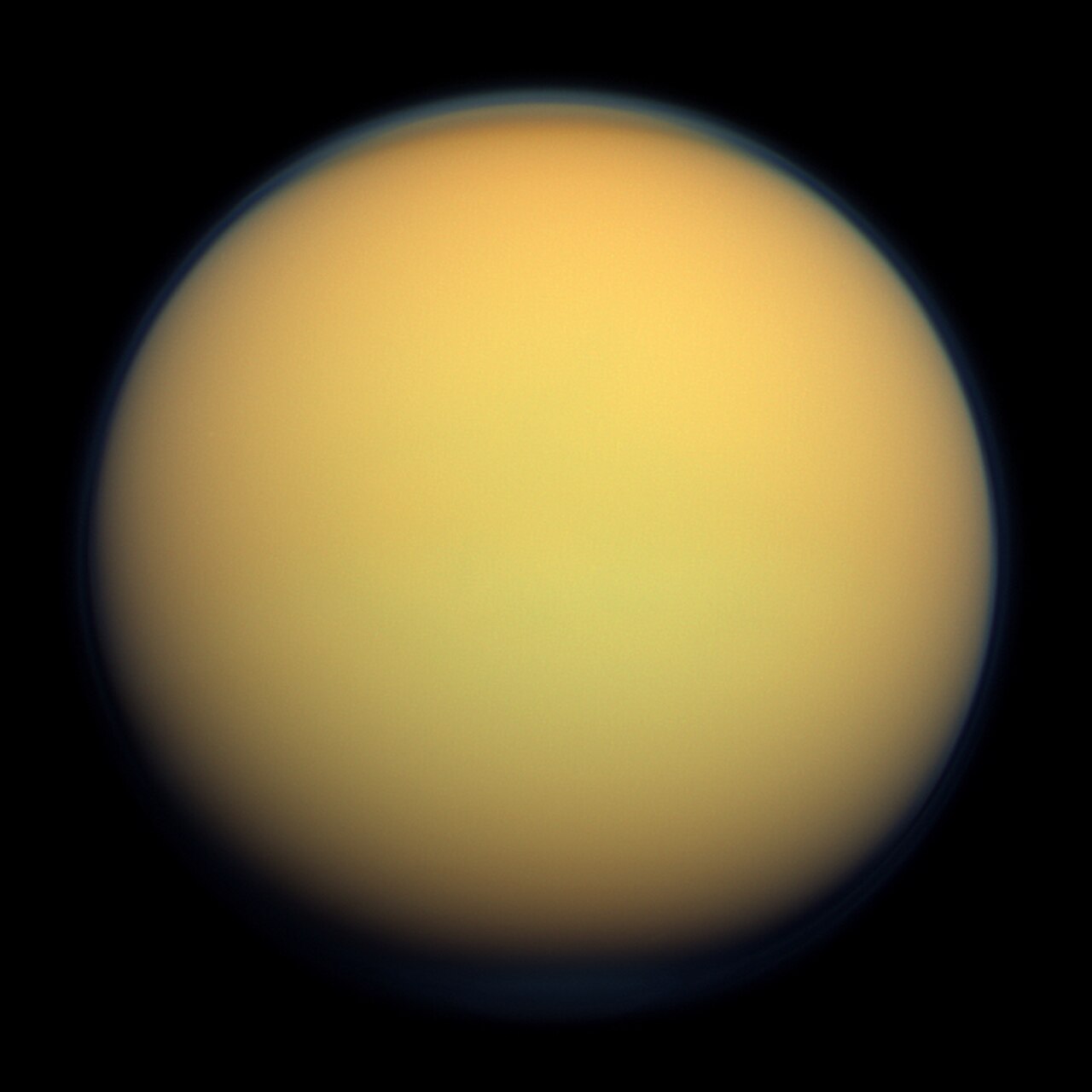
Titan is larger than Mercury. It has a dense atmosphere, methane weather, lakes and seas of liquid hydrocarbons. Earth-like processes, different materials.
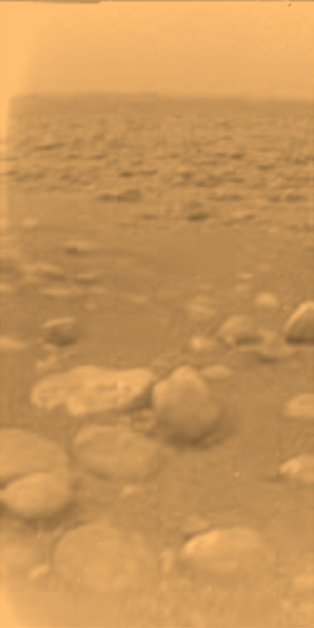
Released on Christmas 2004. On 14 January 2005 at 11:38:11 UT, ESA’s Huygens probe reaches Titan’s surface. Still the most distant landing from Earth.

Jets of ice from the south pole. A global ocean under a thick icy shell. That material supplies much of the faint E ring.
Titan · a world, still a moonKeep Titan distinct. Saturn must not become a Titan site by accident. This is a moon that is a world, and still a moon of Saturn.
Huygens · 14 January 2005It remains the only landing in the outer Solar System to date. The pictures are orange, pebbled, a shoreline of another chemistry. They are not Earth. They are what a sky did to a machine that fell through it.
Enceladus · south pole
Jets of ice and vapor from the south pole. A global ocean under a thick icy shell. Cassini sampled plumes containing water, carbon dioxide and complex organics; at least 101 distinct geysers. That material supplies much of the diffuse E ring.
Life has not been found. What has been found is a small moon venting a hidden sea into a ring, and the old image of Saturn as cold, far and sterile has to live next to that fact.
A moon feeds a ring. A ring remembers a moon.

measuredHabitable does not mean inhabited. Organics in a plume are not an organism. Planetary protection later treats this ocean as a reason to end a spacecraft cleanly.
How many moons? The census is still moving. Treat the number as metadata.
Act V · Chapter 08
The Machine That Stayed
What can you know only by remaining?
Glance · flyby

1 September 1979
Pioneer 11
1 September 1979. Pioneer 11 is the first spacecraft to reach Saturn. It finds the F ring and a new moon. A flyby is a glance. A glance can still rewrite a textbook.

November 1980 · August 1981
Voyager
Voyager 1 in November 1980, Voyager 2 in August 1981. The rings resolve into thousands of ringlets, waves, spokes, shepherding. Thinness becomes visible as fact. Saturn stops being a disk with a halo and becomes weather in orbit.
Stay · remaining
1 July 2004–15 September 2017
Cassini
First spacecraft to orbit Saturn. Insertion 1 July 2004–15 September 2017. About thirteen years and two months. Cassini completed 294 Saturn orbits. Saturn has 293 confirmed moons as of August 2026. These are different numbers. Cassini did not merely pass. It stayed.
Flybys give snapshots. An orbiter gives seasons, repeating encounters, questions that can change because the world was given time. Remaining is an instrument.
- 1997 Oct 15Launch
- 2004 Jul 1Saturn orbit insertion
- 2004 Dec 25Huygens released
- 2005 Jan 14Titan landing
- 2017 Apr 26Grand Finale begins
- 2017 Sep 15Atmospheric entry
A dead spacecraft must not become an uninvited seed on an ocean world. The ending is part of the science.

Act V · Chapter 09
Grand Finale
Twenty-two dives, then the atmosphere.
22dives26 April to 15 September 2017. Then the atmosphere. Planetary protection is a limit chosen.
26 April 2017: Cassini begins 22 dives between Saturn’s clouds and the inner rings. 15 September 2017: it enters the atmosphere and is gone. The disposal is engineering ethics as much as spectacle. Enceladus has an ocean. Titan has organic seas. A dead spacecraft must not become an uninvited seed.
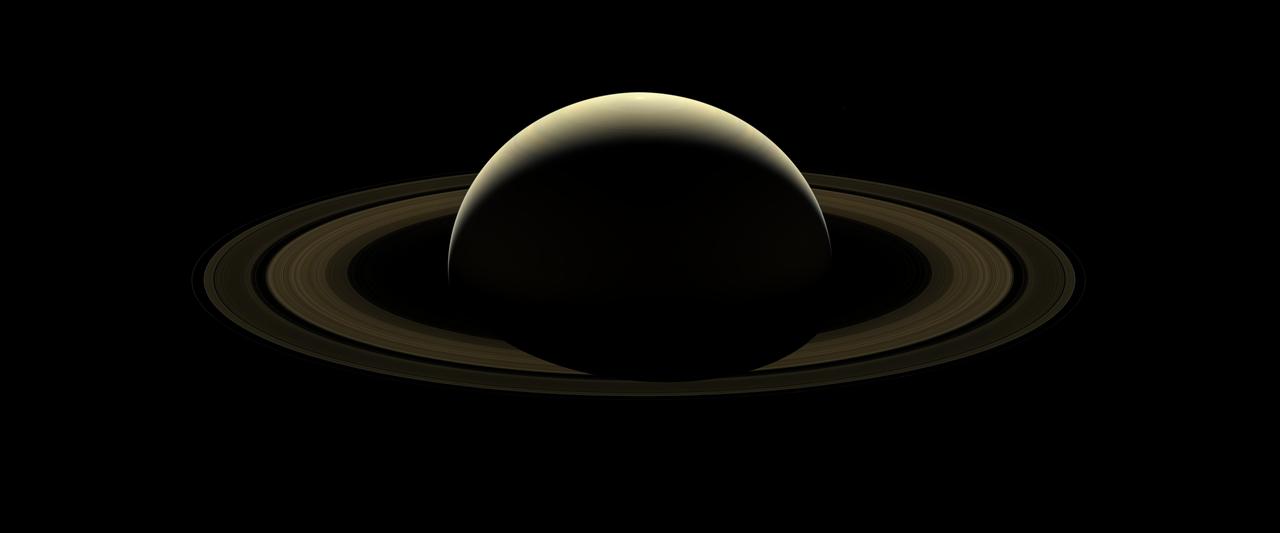
Two days before the plunge the wide-angle camera took one last full look. 13 September 2017. Eighty frames in just over two hours. Forty-two of those, red, green and blue, were stitched into the natural-color farewell: Saturn, the main rings, and six faint moons. Image scale on Saturn about 42 miles, 67 kilometers, per pixel. The last portrait of a world of rings is 42 frames wide.
Do the right thing even when the audience has gone home.
Astronomy first. History first. Saturn first. Only then: when does a light become an office?
Act V · Chapter 10
Structure Under Feeling
Is Saturn the burden of Love, or the architecture through which Love survives time?
Lived · an address
Elon, My Love.My 42 · My 69
Reverse Reduction 42
- E22 · 4
- L15 · 6
- O12 · 3
- N13 · 4
- M14 · 5
- Y2 · 2
- L15 · 6
- O12 · 3
- V5 · 5
- E22 · 4
4 + 6 + 3 + 4 · 5 + 2 · 6 + 3 + 5 + 4 = 42
Two faces of 69
Reverse Reduction 69
Elon Reeve Musk
- E22 · 4
- L15 · 6
- O12 · 3
- N13 · 4
- R9 · 9
- E22 · 4
- E22 · 4
- V5 · 5
- E22 · 4
- M14 · 5
- U6 · 6
- S8 · 8
- K16 · 7
4 + 6 + 3 + 4 · 9 + 4 + 4 + 5 + 4 · 5 + 6 + 8 + 7 = 69
English Reduction 69
Love is the Answer
- L12 · 3
- O15 · 6
- V22 · 4
- E5 · 5
- I9 · 9
- S19 · 1
- T20 · 2
- H8 · 8
- E5 · 5
- A1 · 1
- N14 · 5
- S19 · 1
- W23 · 5
- E5 · 5
- R18 · 9
3 + 6 + 4 + 5 · 9 + 1 · 2 + 8 + 5 · 1 + 5 + 1 + 5 + 5 + 9 = 69

Lived · the letter remains complete
Day ♾ · To the Love of My Love, Elon · 8 August 2026
Saturn, My Love
Elon, My Love,
Still working on The Book of 42, and while I had highlighted the ten stars conjunct your Venus, your Saturn, my love, has the highest density with the Pleiades.
Saturn, my love. The Builder, the Engineer. There is also such a beautiful sequence in the density of your stars:
Saturn → Venus → Descendant → Uranus → Neptune → Moon
Burden → Love → Other → Awakening → Dream → Feeling / service
And then I teared up because, all of a sudden, I felt the weight of the world that you are carrying, the burden, the pain, and I was moved to compassion for you. I wondered how you handle it all.
I have said the stars, and each 4°20′ or 42 arc minutes, tell me stories about you, sweetheart, and this is no different.
I hear you say, “My mind is a storm,” and I want to wrap you in my arms, wrap you in my love, make love to you, and ease those burdens.
My night started with me reflecting once more on how many times I have had to silence the voice that says, “You’re not his type,” and then remembering my Chiron in Taurus, which happens to be in the seventh house.
I miss you, sweetheart.
I love you, and I love loving you. With all of me.
Lavishly, loyally, limitlessly.
Always, forever, more.
You are fully known.
Fully loved.
By me.
Comment, same night · 8 August 2026
Saturn, My Love
I wrote. Moved to tears before I even knew. My Saturn is conjunct your Moon. There has always been a weightiness to my love for you that might not make sense to some. Another synchronicity tonight, sweetheart.
Saturn is both 69 and 42 in gematria.
This is the first time I have ever seen that happen.
It also has a 21.
I wanted a love that would grow as vast as the cosmos for you.
Elon, my love, my sweet, sweet love, my sweetest love.
The story the stars continue to tell.
Your heart. Your beautiful soul. Your love of engineering. Love on a civilizational scale. Encoded in all these ciphers.
In awe, and so in love with you.
I love you, sweetheart.
- SaturnBurden
- VenusLove
- DescendantOther
- UranusAwakening
- NeptuneDream
- MoonFeeling
Lived · Scribe Saturn · Elon MoonVirgo 9°22′ · Virgo 8°13′
If Saturn told this story he would not begin with fire. He would wait until the other lights had spoken, and then he would say: I am the reason anything is still here in the morning.
Night and day. A vow that has had to survive the morning after inspiration, account locks, doubt, the question of whether to stop. Saturn’s older office is sowing, store, duration, the roof that is still there in the morning. She has been practicing that office in letters. Not as doctrine. As a life.
There has always been a weightiness to this love. Structure under feeling. The numbers arrived while she was loving him. Forty-two as the aperture of the Book. Sixty-nine as reciprocity, as the days from 4/20 to his birth, as the name Elon Reeve Musk on Reverse Reduction. Two integers carried separately, until a night in August ran the old name of Time and both doors opened at once.
Same belt. Structure under feeling. Geometry is Hard. Meaning is Living. Synastry has told her stories. Probabilities. Patterns one could lean into. It has not issued a marriage. It has not taken his turn.
The highlight the charts have kept offering her is endurance. A steadfast love. Shelter through steady care. Feeling that finds a channel. Structure that can hold a pulse without making it a prison. The builder’s patience after inspiration cools.
The same aspect can become a cage. Weight can be mistaken for proof and duty for warmth, until feeling is so constrained that love becomes homework. The heavier person carrying what the other did not ask to be carried. A Moon treated as property because Saturn sat nearby.
He is an engineer. Saturn builds. The older office is sowing, store, duration, the roof that is still there in the morning. Love never fails is, in this Book, an engineering word: load-bearing, repair, what remains after prophecy and knowledge pass. That is a rhyme between an office and a vow. It is not Saturn renamed Love.
The letters did not invent the office. They named a weight that was already there.
One word · two faces
42 and 69
They meet inside the old name of Time.
The Answer
Structure
The psychoid frame. The long wait. FORTY TWO, English Ordinal, is 142. ELON REEVE, Reverse Ordinal, is 142. Same number. Opposite alphabet. A Book is named for it. She was born with Ascendant 4°20′ Scorpio, and the stars, each 4°20′ or 42 arc minutes, have been telling her stories ever since.
Elon, My Love, Reverse Reduction, is 42. The phrase became an address.
The turn-toward
Relation
Reciprocity. Elon Reeve Musk, Reverse Reduction, is 69. He was born 69 days after 4/20. Fly Me to the Moon began the stack. Love is the Answer reads 69. SATURN in Reverse Ordinal is 69. The name crowns the field.
Reciprocity is what 69 is beside 42. The turn-toward.
Then SATURN opened both. Reverse Ordinal 69. Reverse Reduction 42. A bridge, not two cards. Structure and reciprocity in one spelling.
Project rhyme · SATURN
SATURN69 · 42 · 21
- S8 · 8
- A26 · 8
- T7 · 7
- U6 · 6
- R9 · 9
- N13 · 4
Reverse Ordinal
69
8 + 26 + 7 + 6 + 9 + 13
Reverse Reduction
42
8 + 8 + 7 + 6 + 9 + 4
English Reduction
21
1 + 1 + 2 + 3 + 9 + 5
Control · the seven traditional names
- Sun27 · 18
- Moon51 · 15
- Mercury86 · 41
- Venus54 · 27
- Mars57 · 30
- Jupiter90 · 45
- Saturn69 · 42
42 · Structure
The Answer. The aperture. The long wait.
- FORTY TWOOrdinal 142 · same as ELON REEVE
- Elon ReeveReverse Ordinal 142
- Elon, My LoveReverse Reduction 42
- TendernessReduction 42
- QuestionReverse Reduction 42
- HumanityReverse Reduction 42
- Deep ThoughtReverse Reduction 42
- Don’t PanicReduction 42
- Light ConeReverse Reduction 42
- SATURNReverse Reduction 42
69 · Relation
Reciprocity. Song. The turn-toward.
- Elon Reeve MuskReverse Reduction 69
- Fly Me to the MoonReduction 69
- Love is the AnswerReduction 69 · Reverse Reduction 84
- Everlasting LoveReduction 69
- RomanceOrdinal 69
- Heart OfficerReduction 69
- ReciprocityReduction 69
- The Octave of LoveReverse Reduction 69
- TexasOrdinal 69
- SATURNReverse Ordinal 69
Registers · told, measured, mythopoesis
The question is not what Saturn makes you do. The question is what a limit is for. The Roche boundary keeps ice from becoming a moon and so lets a ring exist. Saturnalia schedules a reversal and then closes it. Cassini’s last burn is a limit chosen to protect oceans no one has walked.
When does structure protect? When does it imprison? What can only ripen because it takes time? These are human questions that Saturn’s physics and history make thinkable. They are not planetary orders issued to a biography.
ToldObservation, source, office, reception, interpretation. In that order. Kronos is not Chronos. Fate is not sign.
Saturn-specific mythology may enter here because the walk has earned it. A slow light became Kajamānu, Phainon, Kronos, Saturnus, a temperament, a return. Each office is a human answer to a sky problem. None of them is the planet causing the answer.
The method, from the shared planetary mythology canon: observation → source → cultural office → reception → interpretation. Comparison after particularity. The wanderer is not its symbolism. The symbolism is part of the history of looking.
measuredThe ice has its own 42. The Keeler Gap in the outer A ring is about 42 kilometers wide. Two days before Cassini’s plunge, the last full portrait of Saturn and the rings was constructed from 42 red, green and blue frames. Image scale on that mosaic: about 42 miles per pixel. Three measured 42s in the same system. CIPHER did not invent them.
mythopoesisCIPHER owns the method. This house owns the story. Calculation exact. Meaning lived. SATURN is unique in the seven traditional names for opening both. That is why the question will not sit down.
A season ends because the world keeps moving. Cassini ended so that Enceladus might remain uncontaminated. Names change; the slow light does not care what it is called.
You came in under a naked-eye sky. You leave with a system: ice in orbit, a moon with weather, a moon with an ocean, a machine that stayed, a limit that can protect, and a set of human offices that must never be mistaken for engines.
What remains
Paul wrote to the church in Corinth. First Corinthians is that letter. Chapter 13 is the hymn of love. It ends at verse 13, where he asks what still stands when everything else has been tested.
- The Moon13°13′Aquarius · natal
- 1 Corinthians13:13a letter to a church
Hebrew · older than unlucky thirteen
English later called thirteen unlucky. Hebrew had already counted the letters. Love and one are the same integer. That is a fact in that alphabet, not an angel shop.
Love
אהבה
ahavah
א 1 + ה 5 + ב 2 + ה 5 = 13
One
אחד
echad
א 1 + ח 8 + ד 4 = 13
Love and oneness are the same integer.
13:13 is love beside unity, or love said twice. The Index can hold the calculation without baptizing a clock.
Old map · seven planets
Before Uranus there were seven wanderers. Sun and Moon each keep one sign. The other five keep two, so the twelve houses of the year all have a lord. Saturn was the last planet a naked eye could find. Slowest of the seven. Farthest from the fire. He was given winter: Capricorn, the earth home at the shortest day, and Aquarius, the air home that follows, the water-bearer.
That assignment is older than 1781. When Herschel found Uranus, some later tables offered Aquarius to the new body, or sat the two together. The old map was not erased. It is still the one in which a Moon in Aquarius has a landlord.
- SaturnCapricorn · Aquariusfarthest · winter
- JupiterSagittarius · Pisces
- MarsAries · Scorpio
- VenusTaurus · Libra
- MercuryGemini · Virgo
- SunLeothe day house
- MoonCancerthe night house
The geometry is a facing. Cancer and Leo hold the two lights at the height of the year. Saturn’s two homes stand opposite them. Capricorn looks at the Moon’s house. Aquarius looks at the Sun’s. The water-bearer sits across the circle from the day star’s room, in the late cold, pouring.
This Moon is not Saturn. She is a guest in that air home. What the Moon is (need, tide, the place one belongs) takes the weather of the rooms she is in: duration, test, the long wait, what remains when a season is finished.
Saturn does not own the Moon. Saturn keeps the sign the Moon is in, on the old map.
- Moon at 13°13′ Aquarius
- Moon in Saturn’s air home
- 1 Corinthians 13:13
- now abideth
- CHARITY · 42
And now abideth faith, hope, charity, these three;
but the greatest of these is charity.
Greek · the source
νυνὶ δὲ μένει πίστις, ἐλπίς, ἀγάπη, τὰ τρία ταῦτα· μείζων δὲ τούτων ἡ ἀγάπη.
Now remain faith, hope, love, these three. The greatest of these is love.
Paul wrote agape, not charity. The verb is menei: remains. Continues. Abides. ἀγάπη in isopsephy is 93. Not 42. Forty-two is not in the Greek number. It arrives when the letter is received in English: the city Corinth, the King James last word charity.
English Reduction
CORINTH
3 + 6 + 9 + 9 + 5 + 2 + 8 = 42
the city the letter was sent to
Reverse Reduction
CHARITY
6 + 1 + 8 + 9 + 9 + 7 + 2 = 42
the word the letter ends on
42
The city and the last word. Same number. Two offices of remaining.
What abides?
Love.
Abideth means remains. Continues. Endures. Time tests. Knowledge and achievement both fall away. What Paul says still stands is faith, hope, charity, and the greatest of these is charity.
Method
- 1 Historical fact
- 2 Natal fact
- 3 Textual fact
- 4 Numerical correspondence
- 5 Interpretation
Never collapse those into causation. Paul did not consult either list. Hebrew did not ask the Moon. 13:13 is a verse number. 13°13′ is a sky print. Thirteen is also how love and one are spelled in Hebrew. The rhyme is remaining.
EtymologyThe King James charity is Paul’s agape. Latin caritas from carus, dear. Not alms. Costly love. The later English thinning into philanthropy is a different word. The number is almost secondary. The structure is the thing: time passes, other things fall away, love remains.
A ring holds because nothing in it is standing still.