Begin · The Old Sky01
The Old Sky
What happens when some lights will not stay put?
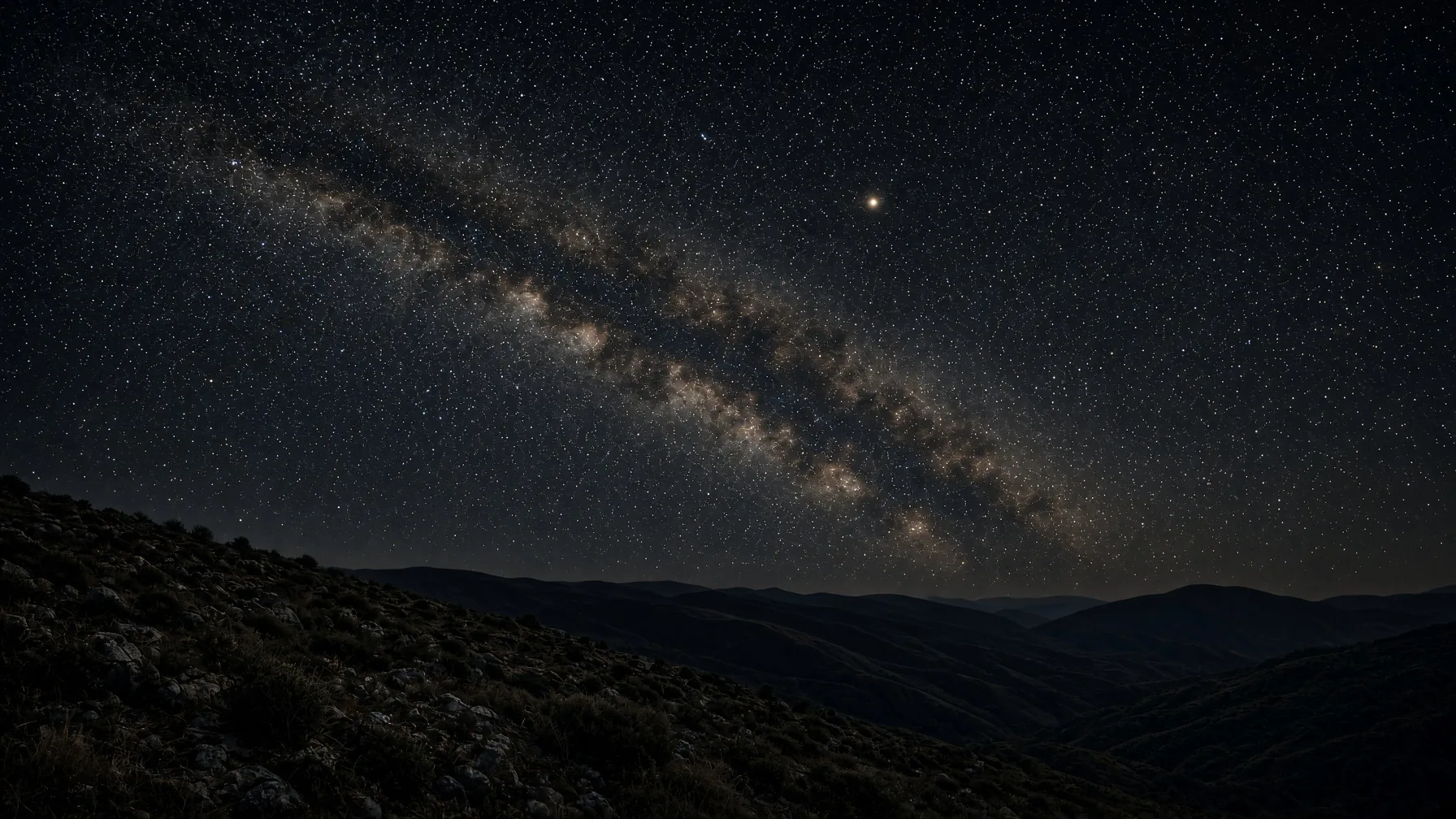
Illustration of a naked-eye sky. Not a photograph of a dated observation.
IllustrationBefore rings, before telescopes. One light among many that will not stay put.
Begin outside. Before spacecraft, before a ring diagram, before a god. The sky is a field of lights that keep their places relative to one another, and a handful that wander.
A clear night. Mediterranean latitudes, or any latitude where the ecliptic rises. · Before 1609. Before any tube of glass.
Greek astronomers called those five naked-eye wanderers planētai: Mercury, Venus, Mars, Jupiter, Saturn. The word is a historical astronomical category. It names apparent motion against the fixed stars. It is not a mystical slogan, and it does not yet mean world.
The ancient category begins with apparent motion, not with modern knowledge of planetary worlds.
- Stilbonthe gleaminglater Mercury
- Phosphorosthe light-bringerlater Venus
- Pyroeisthe fierylater Mars
- Phaethonthe blazinglater Jupiter
- Phainonthe shining onelater Saturn
One apparition
Phainon folds
- eastward
- stationary
- westward
- stationary
- eastward
stationary6.8° fold · 4.7 months in reverseDay 89 of 321
The farthest reverse is the smallest reverse
- Pyroeislater Mars15°
- Phaethonlater Jupiter10°
- Phainonlater Saturn7°
Recordedplanētēs / planētai names the fact of wandering. Later cultures will load the wanderers with offices. That loading is history. It is not the first fact.
Why nextOf those five lights, one lags so far behind the others that a lifetime can fail to finish watching it return. That slowness is the next fact.
The name-lists and what they were for2
- Aristotle / Epinomis. Phainon and the wandering stars. 4th century BCE (name-list tradition). Consulted September 3, 2026.Greek astronomical names of the five wanderers. Phainon (Φαίνων, 'the shining one') is the star-name of the slow wanderer. Kronos is a god-name. Saturnus is later Roman. The three offices are distinct.
- NASA Science. Saturn: Facts. Page updated May 19, 2026. https://science.nasa.gov/saturn/facts/. Consulted September 3, 2026.Public figures for orbit, tilt, rotation, ring thickness and radial extent. Moon count on this overview still cites 274 as of March 2025. If NASA revises a figure, Saturn follows.