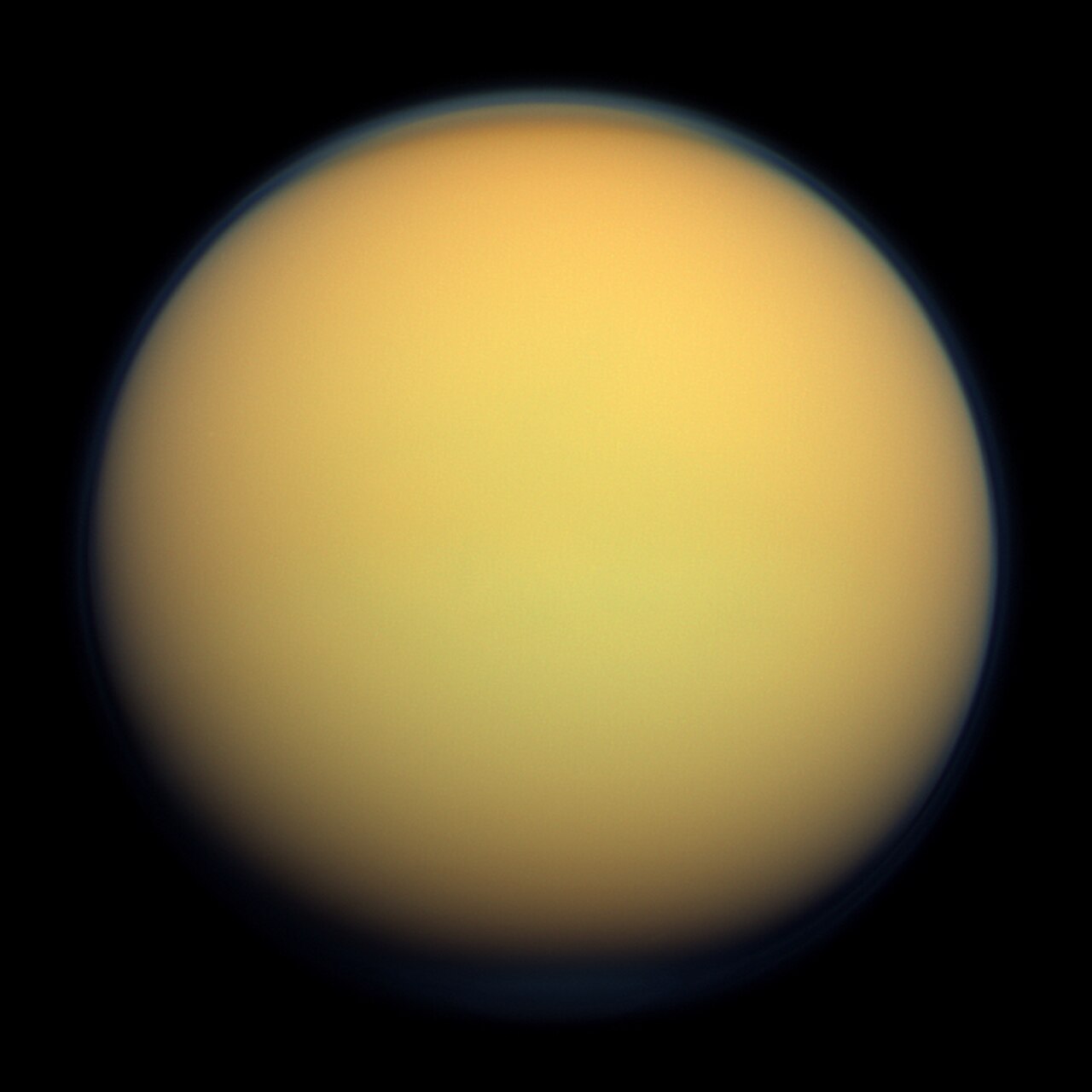
DocumentaryNASA / JPL-Caltech / Space Science Institute. Cassini. Documentary.
A moon with weather, photographed. Nitrogen air, methane hydrology, still a moon of Saturn.A world of worlds · The System20
Titan
What if a moon is a world with weather?
Measured
Saturn’s largest moon. A dense nitrogen atmosphere.

IllustrationIllustration of the Saturn system. Not a single Cassini frame.
A world of worlds. Distances are composed, not to scale.Titan is larger than Mercury. It has a dense atmosphere, methane weather, lakes and seas of liquid hydrocarbons. Cassini found polar seas; Ligeia Mare, among them, is filled with liquid methane over an organic-rich seabed. Earth-like processes, different materials.
Keep Titan distinct. Saturn must not become a Titan site by accident. This is a moon that is a world, and still a moon of Saturn.

IllustrationIllustration. Not a Cassini imaging mosaic.
A moon with weather. Earth-like processes, different materials.MeasuredModeledExaggerated
A planet is not aloneStory grouping lets a reader walk moons. Scale is a different picture.Represented: Authored companions: Titan, Enceladus, Mimas, Rhea, Iapetus, Dione, Tethys. Simplified: Story layout is grouped for reading. Distances are composed.Why nextOn 14 January 2005 a European probe falls through that sky and lands. Still the farthest landing from Earth.
Descent record and DISR frames2
- NASA. Cassini-Huygens mission. Launch 15 October 1997; end 15 September 2017. https://science.nasa.gov/mission/cassini-huygens/. Consulted September 3, 2026.Saturn orbit 1 July 2004, Huygens landing 14 January 2005, Grand Finale 26 April–15 September 2017, 22 dives, 294 orbits, planetary-protection disposal.
- NASA Science. Saturn Moons. Census as of August 2026. https://science.nasa.gov/saturn/moons/. Consulted September 3, 2026.293 confirmed moons as of August 2026. Treated as updateable metadata, not a monument. JPL SSD / IAU MPC announcements through mid-2026.