
IllustrationIllustration of descent. Surface frames remain ESA / NASA documentary elsewhere.
14 January 2005. Still the most distant landing from Earth.ESA Huygens DISR. Farthest landing from Earth.
A world of worlds · The System21
Huygens Falls Through a Sky
What does it mean to land somewhere this far?
Measured
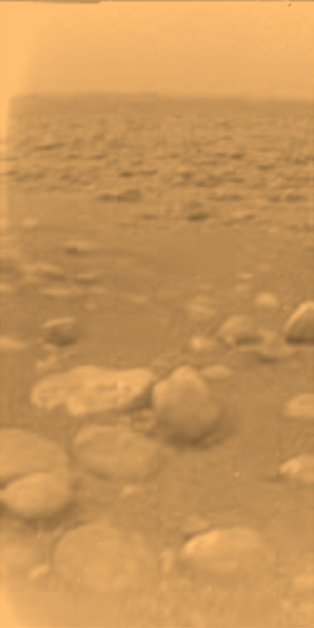
DocumentaryESA / NASA / JPL / University of Arizona. Huygens DISR. Documentary.
14 January 2005. A shoreline of another chemistry.Titan’s atmosphere, then a pebbled shoreline of another chemistry.
Released on Christmas 2004. On 14 January 2005 at 11:38:11 UT, ESA’s Huygens probe reaches Titan’s surface. It remains the most distant landing from Earth, and the only landing in the outer Solar System to date.
- 00:00Entry interface
- +2 minPilot chute
- +3 minMain chute
- +2.5 hSurface · 11:38:11 UT
MeasuredModeledExaggerated
Huygens falls through a skyStill the most distant landing from Earth, and the only landing in the outer Solar System.Represented: Sequential descent phases of ESA’s Huygens probe on 14 January 2005. Simplified: Phase names are sequential and simplified. Timestamps after NASA / ESA mission record.The pictures are orange, pebbled, a shoreline of another chemistry. They are not Earth. They are what a sky did to a machine that fell through it.
Why nextAnother moon is colder, smaller, and feeding a ring while hiding a sea.
Descent record and DISR frames1
- NASA. Cassini-Huygens mission. Launch 15 October 1997; end 15 September 2017. https://science.nasa.gov/mission/cassini-huygens/. Consulted September 3, 2026.Saturn orbit 1 July 2004, Huygens landing 14 January 2005, Grand Finale 26 April–15 September 2017, 22 dives, 294 orbits, planetary-protection disposal.